
104° Dynamics Requirement
Large scale Earth reorientation theories are often discussed in terms of mechanisms: changes in the core, weakening at the core–mantle boundary, mass redistribution, magnetic forcing, or an instability that allows the outer solid Earth to move relative to the deeper interior.
Those ideas are interesting, but before debating which mechanism is most convincing, there is a more basic question to answer: What would the motion itself require?
That’s the question I tested in this case study.
The analysis was motivated by Exothermic Core Mantle Decoupling–Dzhanibekov Oscillation, or ECDO, theory. ECDO proposes a rapid, large scale reorientation of the mantle and crust under particular core–mantle coupling conditions. The proposed displacement is approximately 104º, toward a new pole near 31ºE,14ºS.
I did not use this study to determine whether that target is Earth’s true preferred inertia axis, that is being addressed in a separate study. In this study, I treated both the angle and destination as prescribed.
The question was conditional:
Assuming the mantle and crust move coherently by 104º, how much energy, angular impulse, torque, and path-aligned driving would be required?
This does not prove or disprove ECDO. It is a dynamics constraint screen: a way to identify what must be physically true for the proposed motion to remain viable.
Why was I interested in this?
A proposed process may involve a very large energy reservoir, but that doesn’t necessarily mean the energy is accessible. It may be available over the wrong timescale. It may not transfer enough angular momentum. The associated torque may point in the wrong direction. Or the surrounding material may be unable to move without extreme deformation, friction, heating, and failure.
This is why I separated two questions.. The first is a geometry question:
Is there a preferred direction implied by Earth’s mass distribution and inertia tensor?
The second is a dynamics question:
What physical mechanism could actually move the mantle and crust toward that direction?
This case study addresses only the second question.
Even if a proposed pole is geometrically meaningful, a mechanism still has to move an enormous amount of material through a very large angle. Conversely, even if a mechanism contains substantial energy, that does not guarantee it drives motion toward the proposed target.
A viable model has to satisfy both the amplitude requirement and the direction requirement.
Model and assumptions
I tested several possible moving shell definitions, ranging from the crust alone to the whole solid Earth.
The primary case in this report is the one most directly aligned with the ECDO boundary condition I wanted to evaluate: the mantle and crust move coherently from Earth’s surface down to the core–mantle boundary.
That is not a thin shell.
The moving body extends through approximately 2,891 kilometers of material and has a modeled mass of about
Its moment of inertia is approximately
I then asked what would be required to rotate this shell through 104º over four possible event durations:
one day,
one week,
one month,
one year.
The calculation begins with straightforward rigid body mechanics. A shorter event means a higher angular speed. A higher angular speed means greater surface velocity, kinetic energy, angular impulse, and mean torque.
The energy and torque requirements fall very quickly as the duration increases. Both scale approximately with the inverse square of the event duration.
So making the event slower helps enormously.
But it only solves part of the problem.
The calculation is also deliberately optimistic. It represents a lower bound for coherent motion. It does not include the additional costs of fracturing, internal deformation, viscous dissipation, heating, ocean and ice response, fluid motion, or the work required to weaken and maintain the necessary mechanical boundary.
In other words, the real physical requirement would be higher than the idealized values shown here.
Main result: timescale changes everything
The one day scenario is the most demanding.
To complete the proposed displacement in one day, the surface speed associated with the shell’s relative motion would be about 134m/s.
The kinetic-energy lower bound is approximately
and the required mean torque is approximately
Those are extreme requirements before accounting for losses, deformation, or failure.
Extending the event to one week reduces the surface speed to about 19 m/s and lowers the kinetic-energy requirement to approximately
At one month, the surface speed falls to about 4.4 m/s, and the lower-bound kinetic energy falls to approximately
At one year, the surface speed is only about 0.37 meters per second. The corresponding lower-bound energy is approximately
with a required mean torque of approximately
The year long case is therefore vastly less demanding than the one day case.
But, the mechanism would still have to transfer the necessary angular impulse, maintain the appropriate torque, overcome coupling and dissipation, and avoid mechanically unacceptable consequences.
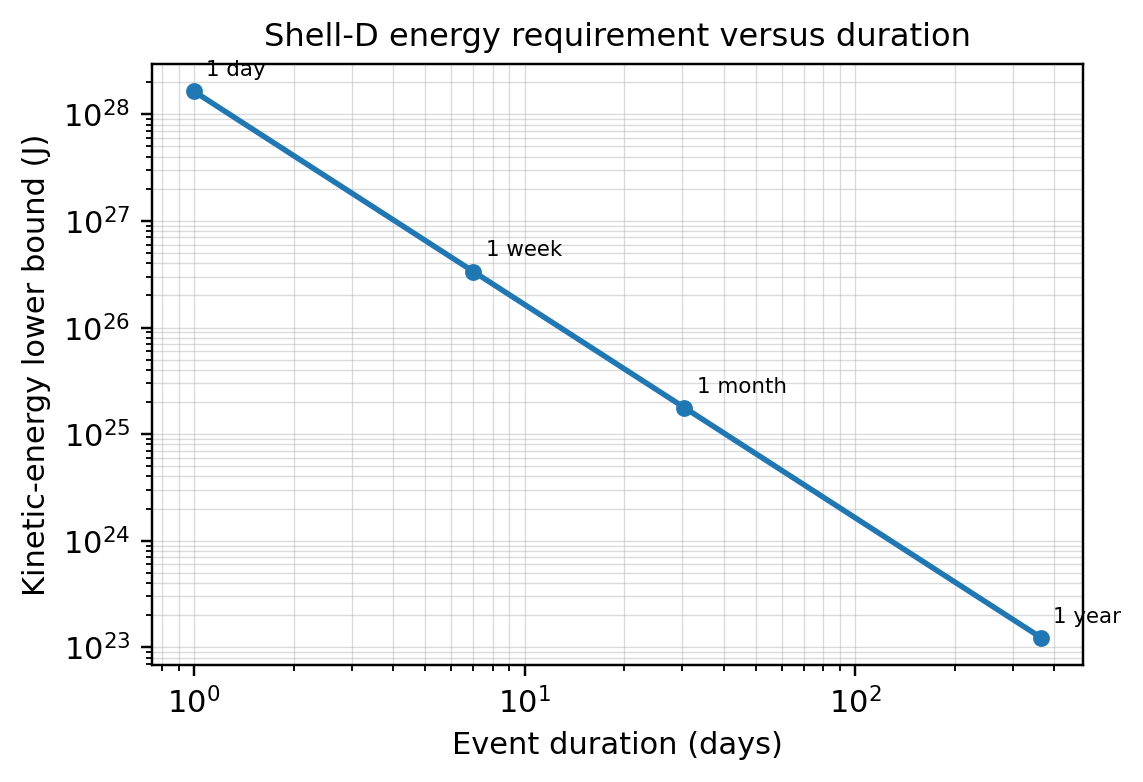
Figure 1: The lower-bound kinetic-energy requirement decreases rapidly as the event duration increases. These values exclude deformation, heating, rupture, dissipation, and other losses.
Energy magnitude is not enough
The second part of the screen asked a different question.
Could the modeled distribution of lower mantle density anomalies naturally assist motion along the prescribed 104º path?
For this test, I used a density-anomaly tensor derived from the CSEM2 lower-mantle model. This is important: the resulting torque is model-derived, not a direct measurement of mantle torque.
The density structure creates an orientation-dependent rotational-energy landscape. As the shell moves along the proposed path, that energy changes. The slope of the energy curve gives the corresponding model-derived anisotropy torque.
This allows us to ask whether the anomaly field tends to push the system forward along the prescribed path or resist it.
The modeled rotational energy scale was approximately:
At first glance, that is interesting because it is comparable to the lower bound energy requirement for the one month scenario and much larger than the one year requirement.
A large energy scale is only useful if the energy decreases in the direction the system is supposed to move. In this case, the modeled energy initially rises along the proposed path. That means the system encounters an energy barrier rather than being continuously pulled toward the target.
The net modeled work along the full path is negative:
The anisotropy torque has the favorable sign over only about 43.7% of the trajectory.
So the natural density anomaly field does not consistently drive the prescribed motion. It resists much of the early path and becomes favorable only later. That’s one of the most important results of the study:
A reservoir can be large enough in scalar energy terms and still fail as a driver because its torque acts in the wrong direction.
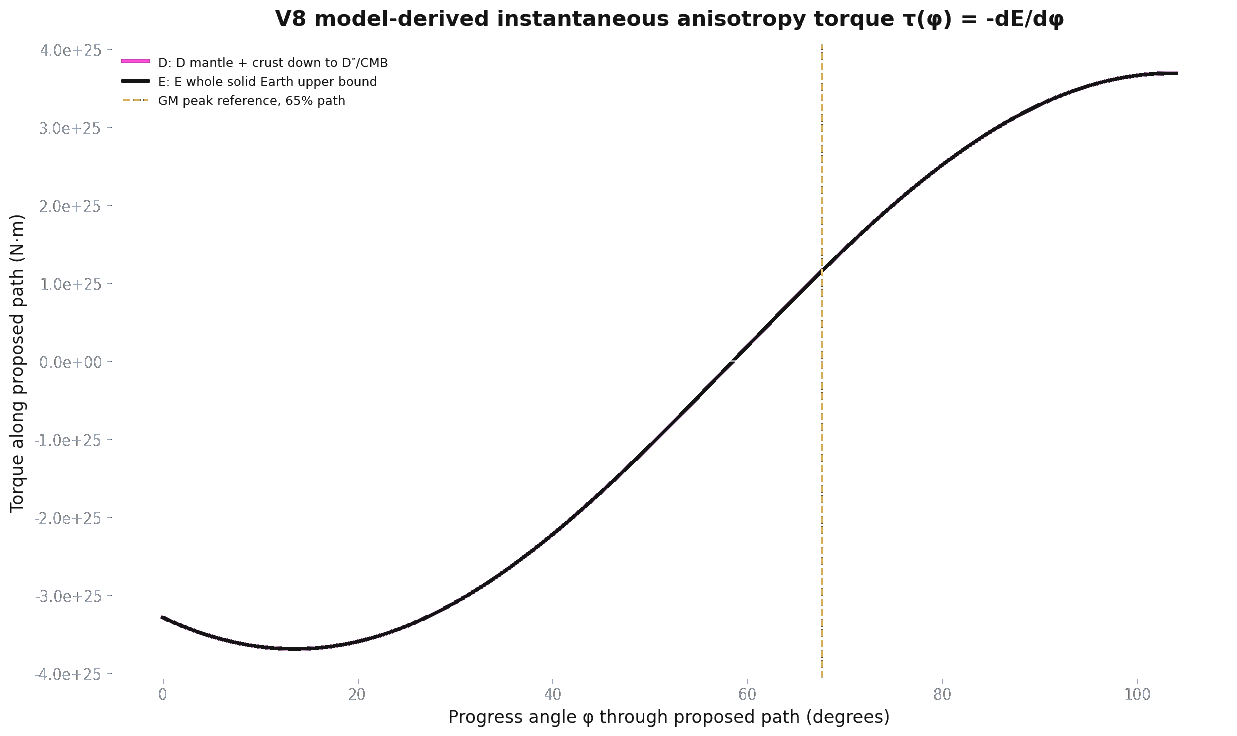
Figure 2: Negative torque resists motion toward the prescribed target, while positive torque favors it. The modeled anomaly field is unfavorable through much of the early path and favorable over only about 43.7% of the trajectory.
What would have to be true?
For the proposed motion to remain viable, a candidate mechanism would have to satisfy several conditions at the same time.
First, it would need to supply the required angular impulse. It is not enough to identify an energy reservoir. The mechanism has to transfer angular momentum to the moving shell in the required amount.
Second, it would need to generate enough positive torque. The torque must be large enough to meet the timescale requirement after resisting forces are included.
Third, the torque must point in the correct direction along the path. Where the modeled anomaly field resists the prescribed motion, another part of the mechanism would have to overcome that resistance.
Fourth, the mechanism would need to overcome coupling and dissipation. The lower-bound calculation assumes an idealized coherent shell. A real event would involve interactions across boundaries, internal deformation, frictional or viscous loss, and redistribution of energy into heat and fluid motion.
Finally, the motion would have to occur without producing mechanically unacceptable failure. A model must address not only whether enough energy exists, but also how stresses are transferred through the mantle and crust and what happens to the oceans, atmosphere, ice, and lithosphere during the event.
Changing the timescale can reduce the amplitude requirement. It does not automatically solve the path-direction problem.
Similarly, choosing a smaller moving shell can reduce the participating moment of inertia, but that becomes a different physical model. It cannot be used as an escape from the full mantle-plus-crust case while still claiming the same boundary condition.
Assumptions
This is a first-pass constraint screen, not a complete simulation of Earth’s interior.
The moving shell is treated as mechanically coherent. That simplifies the calculation but does not describe the detailed deformation that would occur in a real mantle and crust.
The kinetic energy is a lower bound. It does not include rupture, heating, dissipation, fluid response, or the work needed to establish a decoupled boundary.
The target pole and 104º displacement are prescribed rather than independently recovered in this study. Whether the proposed target emerges from Earth’s anomaly fields is a separate inertia-axis problem.
The CSEM2 density-anomaly tensor is model-derived. Its magnitude and orientation depend on the underlying density model, radial weighting, discretization, and other interpretation choices. It should not be presented as a direct observation of instantaneous mantle force.
The analysis also does not close a specific driving mechanism. Magnetic stress, core–mantle coupling, field strength, material weakening, and failure thresholds require their own mechanism-specific screens.
These limitations are not reasons to avoid the calculation. They define what the result does and does not establish.
The study provides a quantitative baseline. Any proposed mechanism can now be compared against explicit energy, angular-impulse, torque, direction, and timescale requirements.
Download the full PDF report
The technical report contains the assumptions, equations, shell definitions, numerical results, figures, limitations, and references behind this summary.
Have a modeling question of your own?
This project reflects the kind of work I enjoy: taking a qualitative claim and turning it into a transparent set of physical and mathematical constraints. That might involve a geophysical hypothesis, an engineering concept, an unconventional mechanism, an inverse problem, or an existing model that needs an independent technical review.
I can help define the question, identify the governing quantities, build a reproducible model, test sensitivities, and communicate the result in a clear technical report or public facing case study.
To discuss a modeling project, contact me to schedule a call.
