
Well, I finally finished testing the electromagnetic induction hypothesis for why the abyssal ocean is warming and the warming is accelerating. :)
I've spent months developing my electromagnetic induction solver to see whether changing magnetic fields could generate enough electrical current to heat the deepest ocean.
What was I trying to explain?
In his 2026 paper, Gregory Johnson reported that the rate of heat entering the abyssal ocean, between 4,000 and 6,000 dbar, increased from approximately 5.4 TW in 1988 to 20.2 TW in 2018. That's an increase of 14.8 terawatts over 30 years.
The paper reports a statistically significant increase for this abyssal layer, although historical full depth measurements are sparse and uncertainty remains important.
We had five hypotheses to test:
Adiabatic compression : could the water only appear warmer because it moved deeper and got squeezed?
Redistribution and isopycnal heave: could density layers be moving up and down and shifting existing heat around?
Antarctic Bottom Water and overturning: could changing deep ocean circulation be carrying warmer water into the abyss?
Geothermal and hydrothermal heating : could heat be entering from the seafloor, ridges, or vents?
Electromagnetic induction and ohmic heating: could changing magnetic fields drive electric currents, and could enough of that electrical energy turn into heat?
We now know enough to narrow it down, and it’s not electromagnetic induction and ohmic heating … here’s why.
The data
To test how strong Earth’s magnetic storms really get, I downloaded real measurements from NASA OMNI, Kyoto, GFZ, and INTERMAGNET. They cover solar wind speed, the direction of the magnetic field, overall geomagnetic activity, and readings from magnetometers on the ground.
From these I found 183 major magnetic storms between 1988 and 2018. The strongest was in March 1989, which reached −589 nT on a storm scale called Dst.
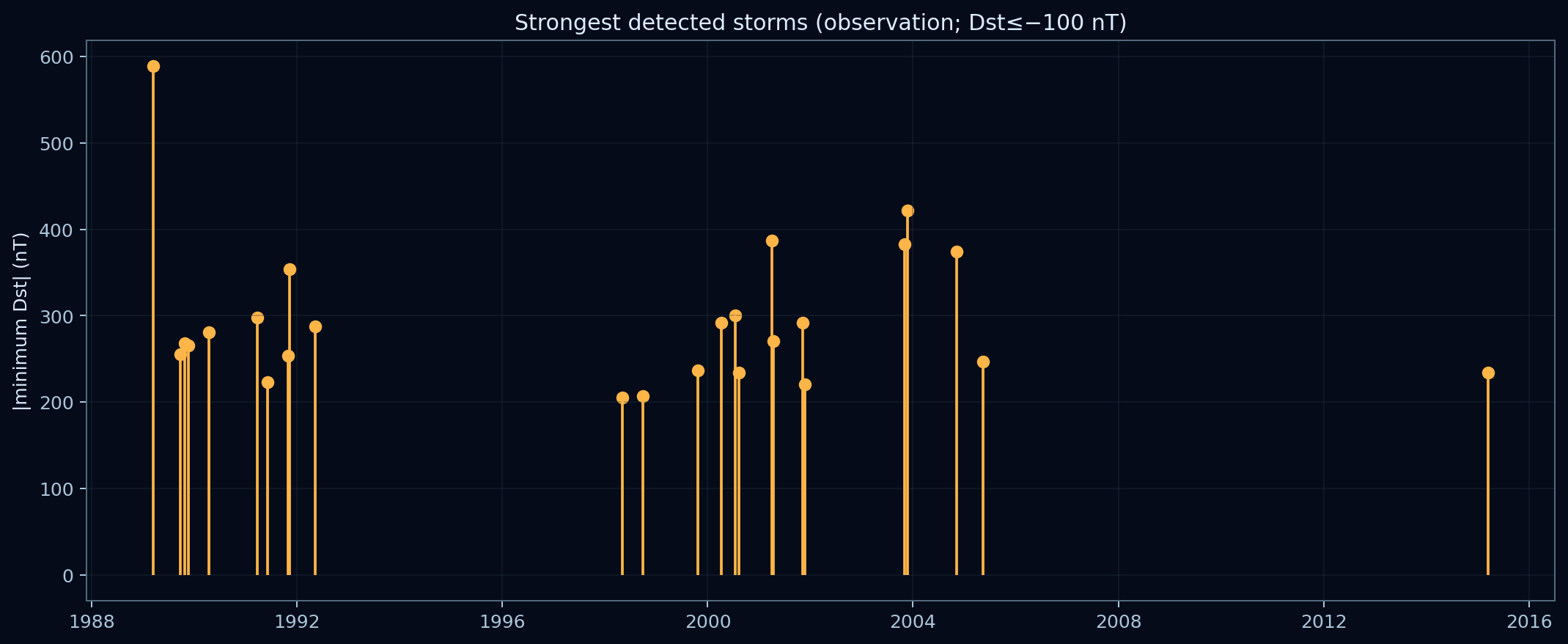
Figure 1. Strongest detected solar storms between 1988 and 2018.
Dst is Disturbance Storm Time, and during a big storm, a ring of electric current builds up around Earth. That current makes its own magnetic field, which partly cancels Earth’s normal field at the surface. The stronger the storm, the more the field is weakened, so the biggest storms have the biggest negative numbers.
My numerical model
I’ve been building my EM solver, which I call the L108 solver, to work out how changing magnetic fields create electric currents in the oceans and the solid Earth. The “108” is how much fine detail the model can capture. It breaks the magnetic field into patterns, from huge ones that span the whole planet down to small ones, and I keep patterns up to the 108th level of detail. At the center of the model is one equation:
This connects three things: how the magnetic and electric fields respond, how well the ocean and rock conduct electricity (σ), and how fast the magnetic field is changing (ω).
And the result?
I set up my assumptions to give electromagnetic heating the best possible chance. For example, I let the magnetic effect act in step across huge areas of the ocean at once. Real conditions would give less heat than this.
Even then, my best case calculation for 2018 gave about 75.8 megawatts of heating in the deep ocean. The observed heat going into the deep ocean (Johnson’s estimate) was about 20.2 terawatts.
That makes electromagnetic heating about 0.000375% of what’s needed, or roughly 266,500 times too weak. Even my highest estimate for any single year only reached 704 megawatts.
But, don’t misunderstand this….changing magnetic fields do drive electric currents through salty seawater, and those currents do make heat. So induction really does add a little energy to the ocean. It’s just a tiny amount.
It also doesn’t match the trend. From 1988 to 2018, the heating from my calculation went down by about 116 megawatts, while the observed deep ocean heat uptake went up by 14.8 terawatts.
I of course also asked how much stronger the magnetic storms would have had to be. The answer: about 52 times stronger just to supply 1% of the 2018 heat uptake. So I’m ruling out historical solar storms as a significant source of the deep ocean’s accelerating warming.
I haven’t disproved electromagnetic ocean heating, I’ve just put a limit on how big it can be, for the storms and assumptions I tested. It produces heat, but too little to explain the acceleration.
My conclusion
Magnetic storms from the sun are not a significant source of heat for the deep ocean, at least for the conditions I tested. Yes, the physics is real, and changing magnetic fields do make electric currents in seawater, and those currents do make a little heat. I didn’t disprove that. What I did was measure how much heat the historical storms could plausibly produce, and it’s way too small to explain the faster warming.
That finishes my electromagnetic study, and with it, my tests of all five ocean heating ideas. Two are still open: water layers moving up and down (isopycnal heave) and heat from the seafloor (geothermal/hydrothermal). Both are limited by missing data, especially the lack of long term Deep Argo coverage.
I haven’t found one main explanation for the faster warming. But, I learned a huge amount about how heat moves through the deep ocean, what the physics allows, and what the data can really tell us. And, that’s exactly why I wanted to do this. :)
