
The Milky Way’s magnetic field doesn’t point a single direction. If you can map it carefully, you’ll find places where it flips direction.
Ben Davidson (X / @SunWeatherMan) thinks those flips aren’t scattered accidents. He thinks they’re the edges of a single structure: a vast, rippling magnetic sheet sweeping outward through the galaxy. If he’s right, that sheet is moving. Which raises the obvious question: where is it, and is our solar system in its path?
I want to find out.
We already live next to one
The Sun has a smaller version. It’s called the heliospheric current sheet: a wavy magnetic boundary that spirals out through the solar system like a ballerina skirt. As the Sun rotates, the folds sweep past the planets, and each time one passes Earth, the magnetic field carried by the solar wind reverses direction. We’ve measured it for decades … it’s real and it’s huge.
Scaling it up to the galaxy
In Chapter 11 of The Sun, The Earth and The Disaster Cycle, Davidson introduces a galactic version running along the Milky Way’s equatorial plane. His numbers:
about 30 light years thick
150 to 300 light years tall
moving outward from the Galactic Center at 700 to 2,000 km/s
He suggests its movement through our solar system could bring magnetic reversals, more dust and energetic particles, and a solar micronova.
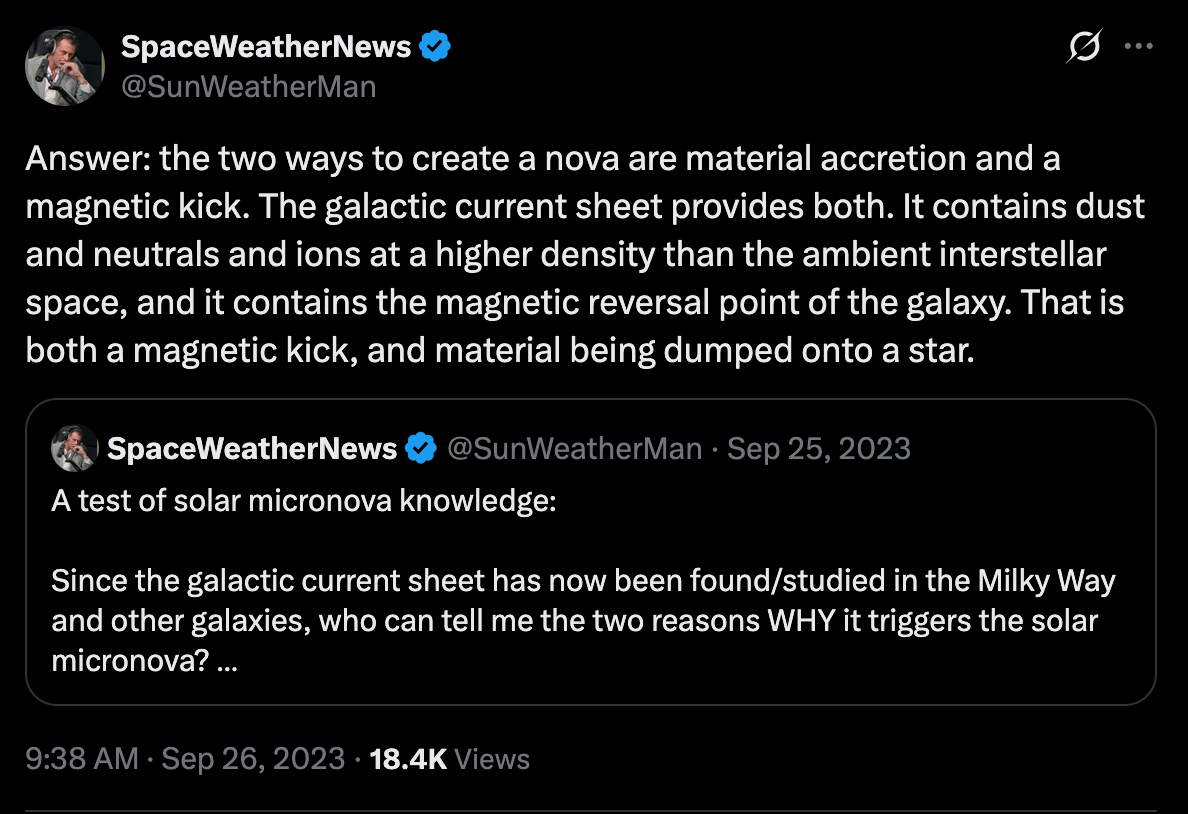
Figure 1. Davidson explaining in September 2023 how novae have two triggers: material falling onto a star (accretion) and a “magnetic kick”: The galactic current sheet supplies both. It’s denser than ordinary interstellar space, carrying more dust, neutral gas and ions, so passing through it dumps material onto the Sun. And it’s where the galaxy’s magnetic field reverses, which is the kick. So when the Sun crosses the sheet, the combination sets off a solar micronova.
Reading the galaxy’s magnetism with dead stars
Pulsars are the collapsed cores of dead stars, spinning and sweeping radio beams across space like lighthouses. As their signals travel to us through magnetized gas, the radio waves get twisted. The direction of the twist tells us which way the magnetic field points along the way.
Where that twist flips sign, the field has reversed. We identified 17 candidate reversal locations and used their estimated distances to rebuild possible three-dimensional surfaces through them. Then we made the shapes compete:
a flat sheet
a tilted sheet
a corrugated wave
a spiral driven by a rotating source at the Galactic Center
The winner, at least in our first predictive test, was the simplest: a nearly flat surface.
Extended toward our neighborhood, that surface lands roughly 610 light years from the Sun.
Following the spiral back to its source
Every spiral has a center, and ours points at a black hole.
Sagittarius A* sits at the center of the Milky Way, four million times the mass of the Sun. The GRAVITY Collaboration has watched hot spots of emission spinning around it, and the Event Horizon Telescope has imaged magnetic fields there that are very organized.
So we built a model with the black hole’s neighborhood as the driver:
Φ(r,φ,t) = m[φ − Ωₛ(t − τ(r)) − φ₀]
This means, the farther out you go, the older the rotation you’re seeing. The faster the center spins and the slower its influence travels, the tighter the spiral.
Separating magnetism from everything else
The galactic disk ripples for reasons that have nothing to do with magnetism: gas piles up, and the disk itself bends like a warped record. We checked our surfaces against the new three dimensional magnetic and hydrogen maps from McCallum et al. (2026) and their H I atlas, and against the bending wave physics of Griv and Yahalom (2026).
That let us strip out ordinary gas structure and gravitational warping, isolate the magnetic geometry, and pinpoint exactly where the map still needs direct measurements.
The goal: when does it hit the heliosphere?
Our whole goal is to find out when the Galactic Current Sheet intersects with our heliosphere next, because the next time it does, there’ll be a solar micronova.
A corrugated sheet doesn’t hit only once, it ripples, and each crest sweeps past in turn, like waves rolling onto a beach. One crossing, then quiet, then the next…. That’s the kind of structure that could produce a recurring cycle. Mathematically, we’re looking for the next moment when a crest and the heliosphere share a point in space:
F_GCS(x,t) = 0 and H_heliosphere(x,t) = 0
What matters for timing:
the spacing between crests
the height of the ripples
how fast the wave pattern moves, and in which direction
the Sun’s own motion: it orbits the galaxy at roughly 230 km/s
What we’ll calculate:
the date the next crest arrives
how often crossings repeat
where on the heliosphere first contact happens
how long each crossing lasts
Davidson’s numbers already narrow the field. For a 12,000 year rhythm at 700 to 2,000 km/s, the crests would need to be 28 to 80 light years apart. And since he proposes a sheet about 30 light years thick, the crests have to be farther apart than that, or they would overlap. That only works at speeds above about 750 km/s. So his own numbers set a minimum speed, and that’s a specific, testable prediction.
The heliosphere’s shape matters too. At these speeds, a crest would cross from the heliosphere’s leading edge to the Sun in a few months to most of a year. First contact happens on one side of our magnetic bubble long before the Sun itself is touched.
What comes next
Three measurements turn the model into a date:
Magnetic polarity near the Sun. Nearby pulsars, plus direct readings of the interstellar field from Voyager 1 and 2 and NASA’s IBEX at the edge of our heliosphere, to find where the nearest crest is right now.
The plasma it moves through. The conditions that set how fast a magnetic wave can travel.
The link to the Galactic Center. Whether the pattern near Sagittarius A* really drives the ripples we see out here.
My goal is to calculate when its next crest reaches the heliosphere, and ultimately, I want to know when there will be another solar micronova.
