
The Milky Way is threaded with magnetic fields, and in very specific places those fields flip direction. I've spent the last few weeks mapping where this sign flip occurs.
If you've been following my Galactic Current Sheet research, you know where this is all headed: a three dimensional model of the sheet that lets me calculate when it could next meet our heliosphere.
Last time, I was working on the shape of that surface and what might move it. Since then, I've had a chance to talk through the research with Ben Davidson (X / @SunWeatherMan), whose work proposed the Galactic Current Sheet in the first place.
I brought him two problems I'd run into. The first was speed. In ordinary interstellar gas, magnetic disturbances travel at roughly 20 to 190 kilometers per second. The sheet is proposed to move at 700 to 2,000 kilometers per second. Reaching those speeds would need magnetic fields 15 to 50 times stronger than what's measured near the Sun. The second was corrugation. My corrugated surface rises and falls by about 256 parsecs. But when I modeled how much a disturbance at those speeds would actually push the gas of the Galactic disk, it moved only 0.3 to 2.6 parsecs, a hundred or more times too little.
He clarified a crossing would take only a couple of days, so we wouldn’t be in it for too long. The sheet is coming from the direction of Pluto, Neptune and Uranus, i.e, the center of the galaxy, so these planets may be showing signs first because of that or because they are farther away from the Sun’s protective heliosphere. Ben has also calculated there should be 4 to 50 peaks and valleys of the galactic current sheet between the Sun and the Galactic Center. Our full conversation was recorded and is available to CRA members: https://catastrophism.org/membership/
A magnetic map of the Milky Way
In 2024, Michael Unger and Glennys Farrar published The Coherent Magnetic Field of the Milky Way, one of the most complete reconstructions of our Galaxy's large scale magnetic field. They built it from two kinds of observations: Faraday rotation, which measures how magnetic fields twist radio waves passing through them, and polarized synchrotron radiation, which traces the field's orientation across the sky.
What makes their work especially useful is that they didn't stop at one model. They built eight, collectively called UF23. Each version changes a single assumption: how electrons are spread through the Galaxy, the shape of the field, how it extends above and below the disk.
That gives us a built in robustness test. If a feature shows up no matter which assumptions you choose, it's worth a closer look. I've brought all eight into my research, and I can now calculate the strength and direction of the modeled field anywhere in the Galactic disk and the halo around it.
Next, I went looking for the reversal surfaces hidden inside those equations.
Where the field changes direction
At any point in the Galaxy, the magnetic field can be split into three directions:
Radial: toward or away from the Galactic center
Azimuthal: around the Galactic center
Vertical: above or below the Galactic plane
Together they make up the full field:
I calculated all three throughout the Galaxy, then extracted the three dimensional surfaces where each one passes through zero and flips sign. The azimuthal reversal surface, for example, is wherever:
These are the boundaries between regions where part of the field points one way and part points the other. Here's what came out.
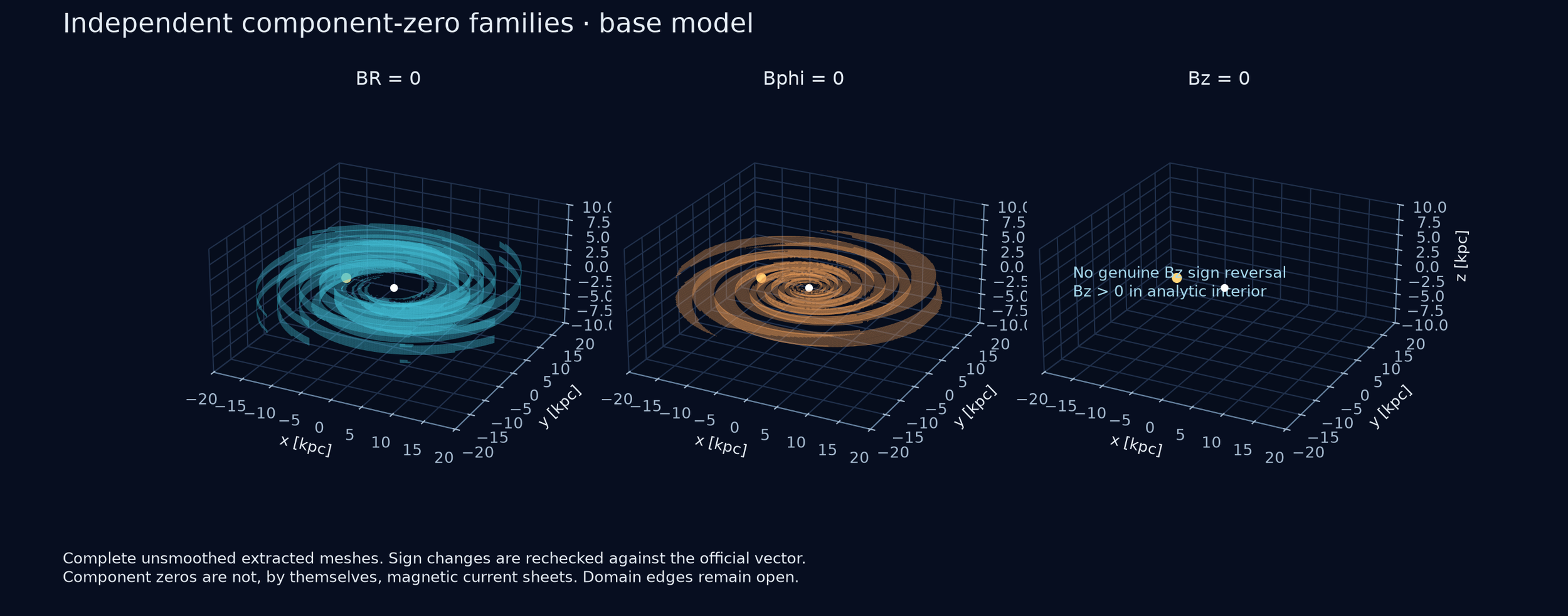
Figure 1. Three dimensional magnetic component reversal surfaces extracted from the published UF23 base model. Blue represents radial reversals and gold represents azimuthal reversals.
In figure 1, the blue surfaces mark where the radial field reverses, and the gold surfaces mark where the azimuthal field reverses. There's a lot more structure than I expected. Across all eight models, I extracted 561 connected pieces of these boundaries. After screening out the small ones and those without a clean sign change, 199 remained. Some of that fragmentation comes from the extraction process itself, so these aren't 199 separate physical structures.
Two huge magnetic boundaries
Next, I asked which structures persist across the different versions of the model, and… two stood out. Both lie north of the Galactic plane, both mark reversals in the azimuthal field, and both appear in six of the eight published models. And they're huge:
They stretch across much of the Galaxy, rising from near the plane to about 4,100 light years above it.
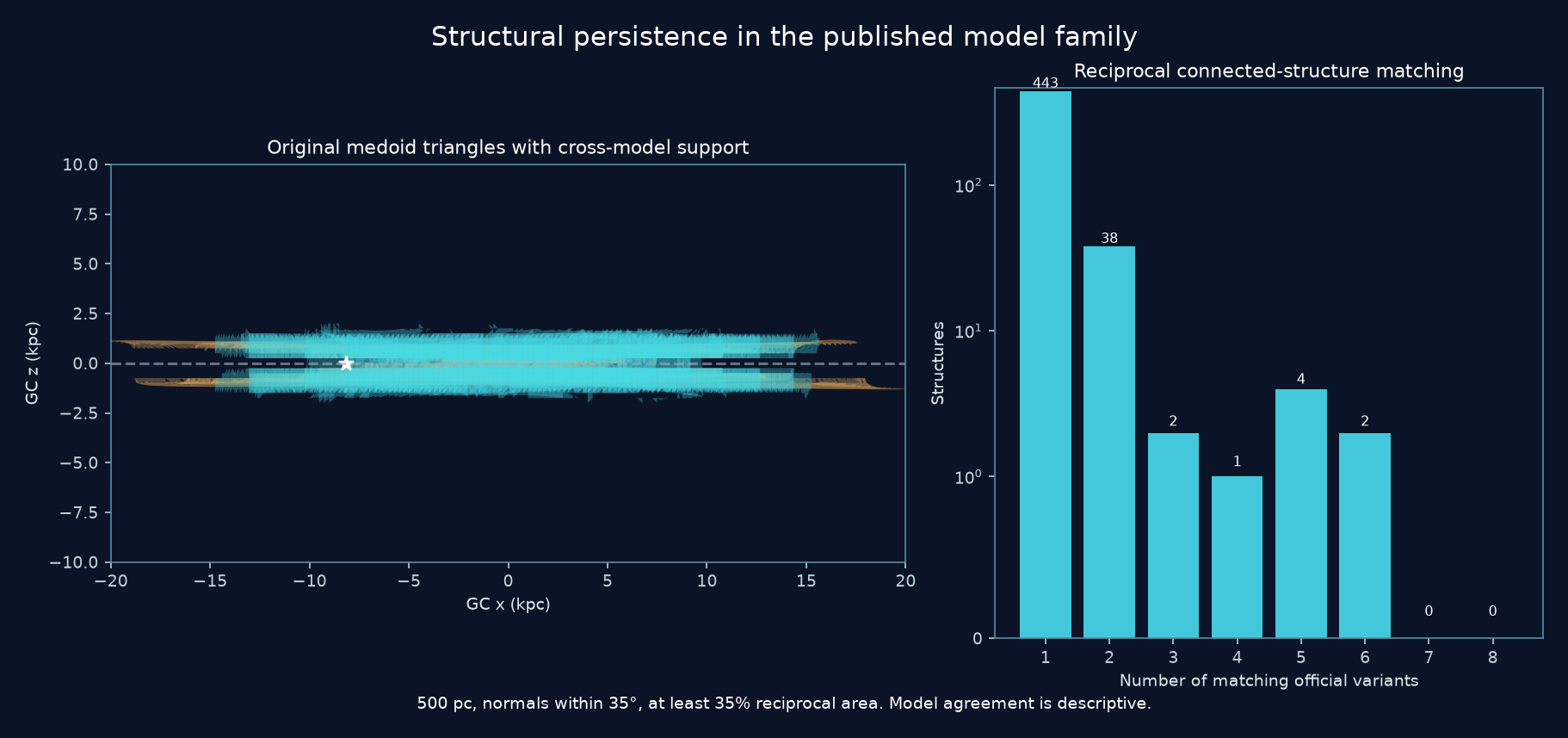
Figure 2. Two extended magnetic reversal structures persist across six of the eight published Galactic magnetic field variants.
For now, I'm calling them Northern Structure A and Northern Structure B.
What makes them interesting is that they hold up even when the assumptions behind the field change. The six models share observational data and some of their math, so this isn't six independent detections. But it's a strong reason to look closer.
How close are they?
The first thing I wanted to know was how far they are from us. Northern Structure A, the median nearest distance across its six models, is close by:
Northern Structure B is much farther away:
Closer to our solar neighborhood, there are smaller reversals too: one about 105 light years away and another about 243 light years away. These depend more on which version of the model you use.
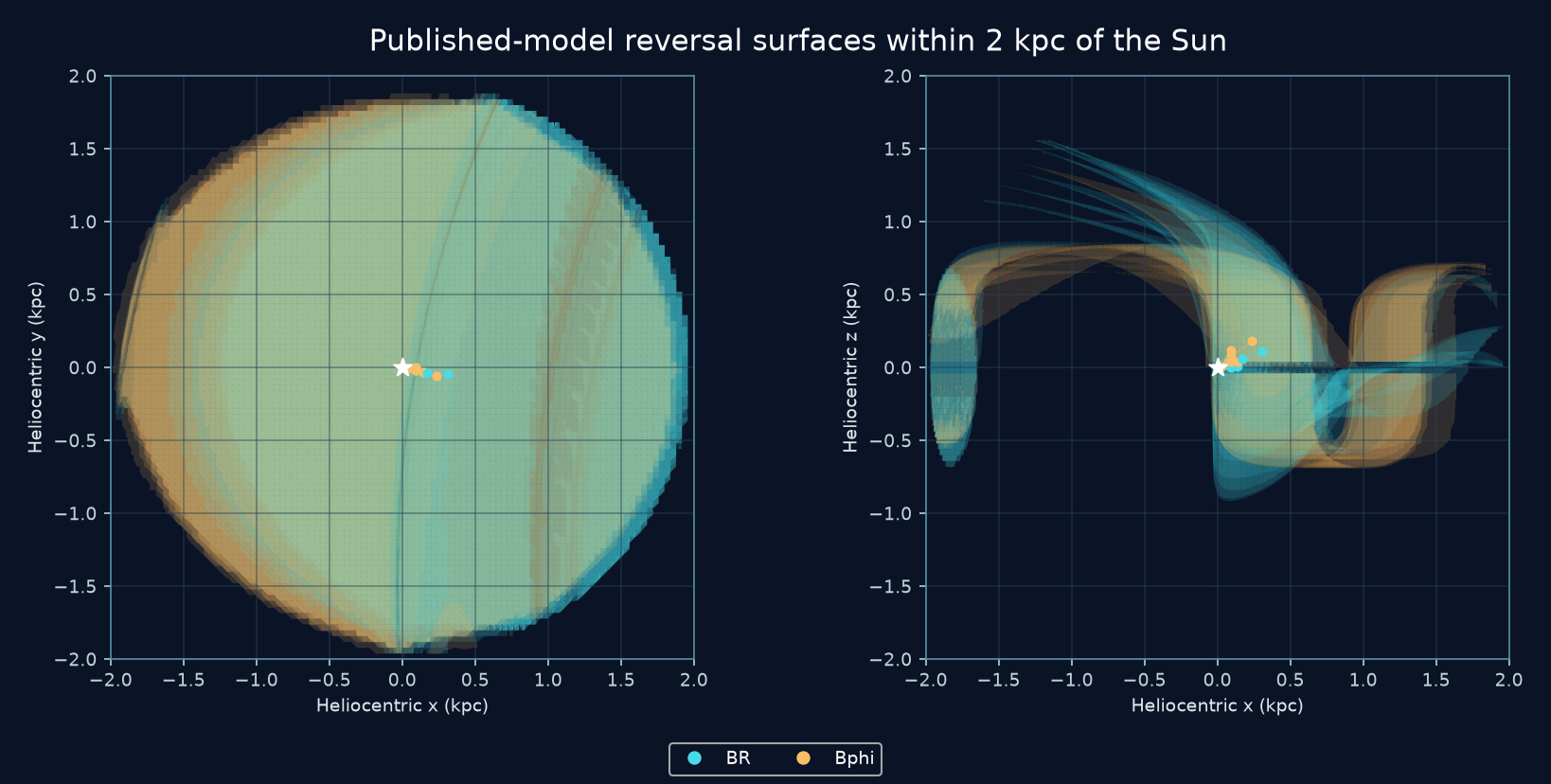
Figure 3. Magnetic component reversal surfaces within approximately 6,500 light years of the Sun. The white star marks our Solar System.
These are distances to reversals inside the models. Whether those boundaries really sit at those locations in the actual Galaxy is what comes next. Northern Structure A is my leading candidate right now. It's huge, it's relatively close, and it persists across the reconstructions.
Is a reversal the same as a current sheet?
Not necessarily, and this is where the physics gets interesting. magnetic field can turn gradually as you move through space. One of its components can pass through zero while the overall field stays strong. A current sheet is something more specific: a concentrated layer of electric current where the field changes direction.
To tell the difference, I calculated the electric current implied by the published field using Ampère's law in its magnetoquasistatic form:
That operation, the curl, measures how the field twists and turns through space. Within this approximation, it gives the current needed to produce that twisting. Some reversal surfaces carry almost no extra current. Others are much more interesting.
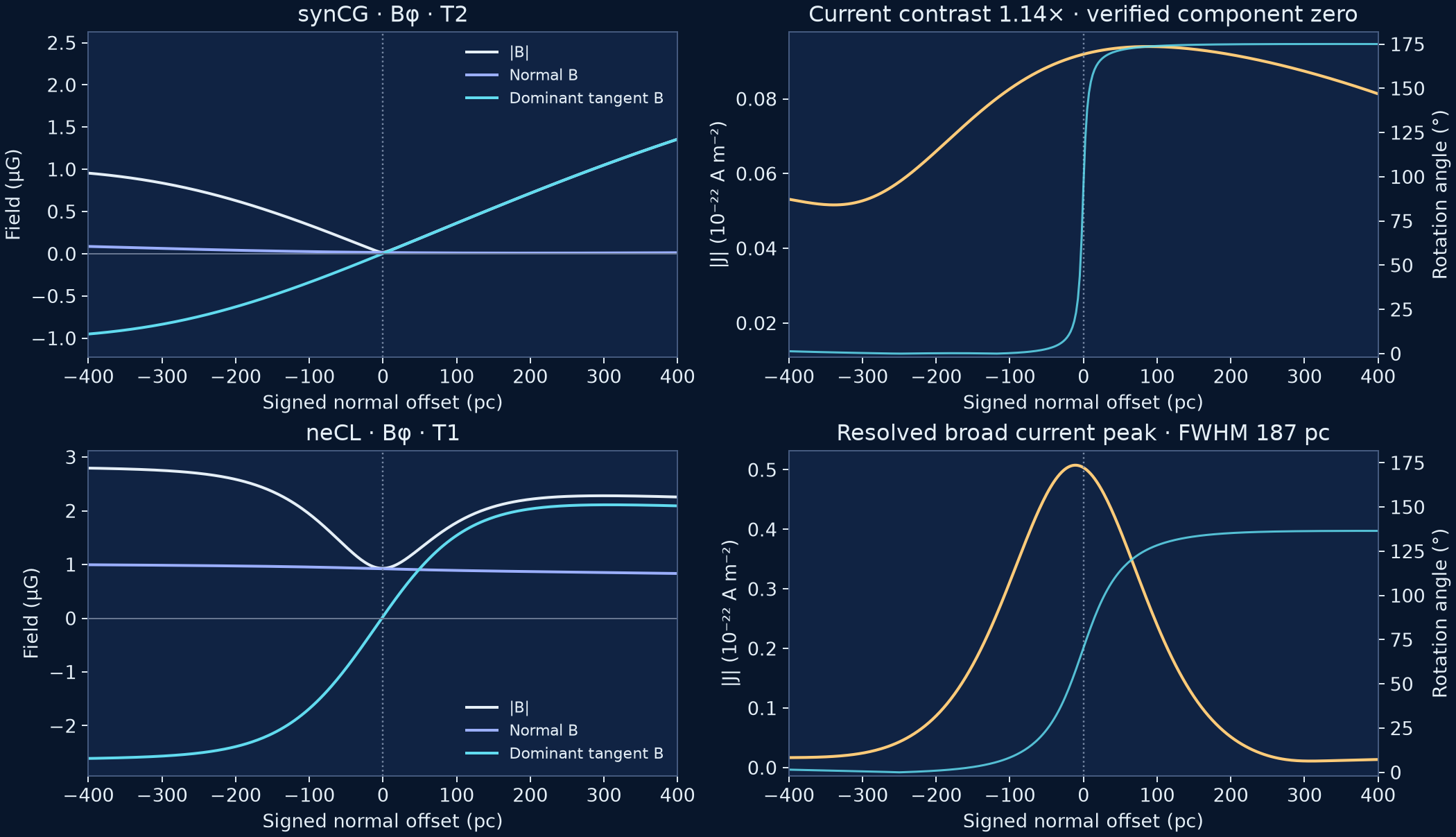
Figure 4. Two modeled magnetic transitions illustrating the difference between a distributed magnetic reversal and a reversal associated with concentrated electric current.
In one of the examples in Figure 4, the magnetic field along the surface changes direction by approximately 168°, so the tangential fields on opposite sides are pointing in nearly opposite directions. The calculated electric current density becomes 7.4 times stronger than the surrounding reference level. The model produces a broad transition with a current peak approximately 188 parsecs wide.
Across the eight models, I identified 303 sampled locations with similar broad current layer characteristics under our wider screening criteria. Many of these occur where the published model transitions between the magnetic field of the Galactic disk and the surrounding halo.
We haven't identified a narrow, connected physical current sheet yet, but we now have specific magnetic transitions whose electromagnetic properties we can investigate.
Does the field ever reach zero?
This is important because of the proposed link between Galactic magnetic reversals and solar activity. The total strength of the field depends on all three components:
I found more than a thousand locations where the radial and azimuthal components both pass through zero at the same point. But the vertical component is still there in every case, so the total field never vanishes. A current sheet can exist with some field still present.
One more intriguing detail: all eight published models contain a mathematical boundary right at the Galactic midplane.
Next Steps
I'm now following six of these structures, with Northern Structure A at the top of the list. The plan is to trace the paths from Earth to known pulsars through these boundaries. If two pulsars sit in roughly the same direction, one in front of a boundary and one behind it, their signals can tell us whether the field really flips there.
I'm also bringing in local magnetic field reconstructions, starlight polarization and published studies of the plasma between us and those pulsars, to pin down what's happening along each path. Once I've identified the transitions that independent observations support, I'll use them to build our own surface model. Then I can study its shape, test for corrugation, and work on the physics of how it might move.
And, that brings me back to the question that started this whole project: when will the Galactic Current Sheet intersect with our heliosphere?
Our foundation is much stronger now. And the deeper I go into the Galaxy's magnetic structure, the more fascinating it gets.
References
Unger, M. & Farrar, G. R. (2024). The Coherent Magnetic Field of the Milky Way. The Astrophysical Journal, 970, 95.
The magnetic reversal surfaces, current density diagnostics and structural persistence analysis presented here are from my own numerical investigation of the eight published UF23 magnetic field models.
